
by: Steven Carruthers
Practical Hydroponics & Greenhouses Australia
In the competitive world of marketing and communication, brand building and relationship marketing is a powerful combination. Brand building is about product identification and trust, and relationship marketing is about establishing profitable relationships with customers and consumers that really last. In the fresh produce market, it’s something the organics industry does really well, and the hydroponics industry does poorly. While organic produce sales continue to grow worldwide, hydroponic produce is seldom marketed as such in supermarkets, with growers battling to differentiate their product from their competitors and overseas imports.
According to many consumer studies, people generally buy organic food because it is seen to be healthier and more natural than its non-organic equivalents. A recent study by the NZ Vegetable Growers Federation (VegFed), found that nearly 40% of people who purchase organic food do so because they believe it is pesticide-free. Of course, that’s not always true, but that’s the power of marketing, and an industry able to communicate its marketing message.
I’m not aware of any consumer research on hydroponic produce, however, I would venture to say that consumer perceptions would weigh heavily in favour of produce that is grown using artificial fertilisers or ‘chemicals’, and that freshness, quality, taste and shelf-life would hardly rate a mention. Many consumers believe hydroponic tomatoes are picked green, gassed to ripen, and that they are flavourless. Nothing could be further from the truth, but how do hydroponic growers convey their marketing message through the marketing chain to the end user? Consumers also think hydroponic tomatoes are high priced, but with the arrival of imported hydroponic tomatoes from New Zealand, and soon from the Netherlands, this perception may change.
Neither the organic nor the hydroponic industry can claim they are pesticide free, although hydroponic and greenhouse growers are headed that way with the adoption of Integrated PestManagement (IPM) strategies.
Today, not all supermarkets market hydroponic tomatoes as such, and less so in farmers markets and the corner fruit and veg store. Hydroponic tomatoes are definitely tomato non grata at organic markets.
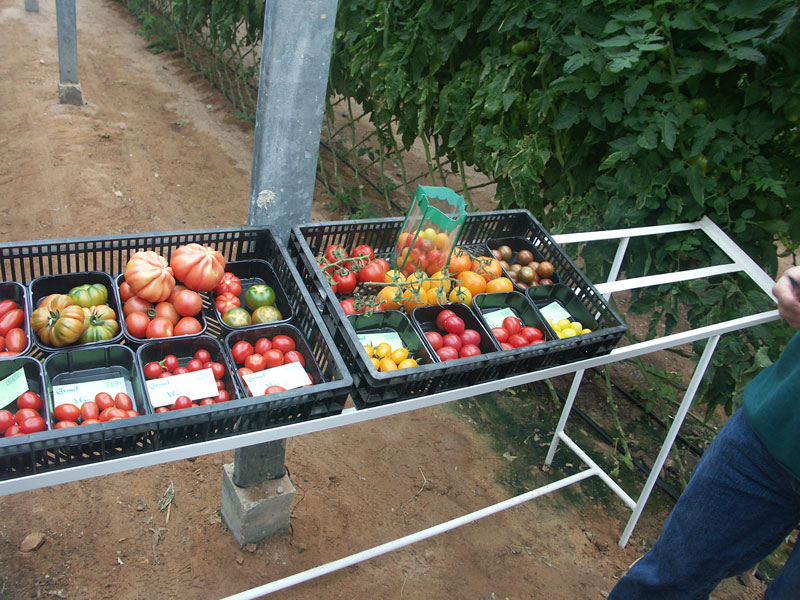
Instead, tomatoes are marketed as ‘vine-ripened’, ‘truss’ or ‘cluster’,‘ greenhouse’ or ‘gourmet ’tomatoes, which may or may not have been grown hydroponically. In Canada and parts of the US, they are marketed as ‘Tomatoes on the Vine’and ‘ Cherry Cluster Tomatoes’. Supermarkets use these names as a gimmick or a way of attracting the buyer, each saying that my tomatoes are fresher and better than competitor’, a claim usually reflected by price.
In the context of fresh food marketing, branding is an important source of information in consumer decision making. It offers three specific benefits:
• Product quality - consumers will often pay more for a product that they associate with high quality and dependability.
• Innovation - innovative products are usually heralded by a new name.
• Choice - Consumers value the freedom of choosing from among the many offerings in a given product category, and branding makes this possible by identifying each offering.
From a food wholesaler and retailers perspective, branding strategies revolve around ensuring that a brand name will stick in consumers’minds. To achieve this marketing goal, they consider fresh produce branding in the context of market segmentation and promotional strategy, developing brand names that help promote a unique image and character that may allow for price differentiation.
Branding is so universal a marketing strategy, that it is difficult to isolate its benefits for fresh produce marketers. However, it is particularly important for:
• Market control - where branding can assist an organisation in obtaining a significant share of the market for its product. Once a product becomes established, a well-known brand name can help it retain its position.
• Pricing independence - where branding enables a company to charge more or less money for a product than its competitors.
.jpg)
• Product introduction - one of the factors that can entice consumers into using a new product is an appealing product name. Some marketers may try to link their new offering to an already respected brand or name, while others may choose a new name that promises excitement or satisfaction.
• Promotional advantage - when a brand name is firmly fixed in the consumer’s mind, promotional campaigns are apt to be more effective and less expensive.
• Positioning - a new brand name can often help to reposition a product line in the market.
In the context of tomatoes as a commodity group, fresh produce marketers use brand building and market relationship strategies to create different tomato segments, such as Truss, Vine-ripened, Greenhouse and Gourmet tomatoes, which may or may not be hydroponically grown.
In the US, Howard Wener, a Vegetable Consultant with AgriSupportOnline said truss and cluster both mean the same thing. The truss or cluster is the place on the tomato vine where the flowers form and turn into fruit. “The term truss tomatoes is not used in North America,” said Mr Wener.“ Tomatoes that are picked as a cluster or truss are often called cluster tomatoes and are larger than cherry tomatoes, but smaller than the normal greenhouse tomato. “In Canada and parts of the US, they are called TOV’s or 'Tomatoes on the Vine'. Cherry tomatoes when picked as a cluster are more commonly referred to as 'Cherry Cluster Tomatoes',” he added.
Mr Wener said that greenhouse tomatoes should refer only to tomatoes grown and picked from greenhouses. However, because indeterminate tomatoes, which were bred for greenhouses are now grown outdoors, the term has become somewhat confusing. “Some people will call any indeterminate tomato grown outdoors on good staking a greenhouse tomato because of the shape and size,”said MrWener.“ I think this is partially done to convince the consumer that it is a better product, ”he added.
Of vine-ripened tomatoes, Mr Wener said this is a very “explosive” term. He said that everyone seems to have a different interpretation of what it means. “In the States, you often see a sign in the supermarket that says vine-ripened tomatoes, but they have been ripened artificially with ethylene gas. They are picked at the ‘breaker stage’, which simply means that they have good size and should be ready to turn colour. The gas is used to hurry them along,” he said.
Mr Wener said that this is one definition of vine-ripened, but most people would like the term to mean that they have been picked red after having ripened on the vine. “In NorthAmerica, it is mostly the big outdoor growers with determinate varieties, using the gas method, who advertise their tomatoes as vine-ripened, ” he said. “ Determinate tomatoes that are picked red are not usually sold in big supermarkets, but rather at farmer’s stands, and they do not need advertising. The colour and taste speak for themselves,” he said.
Mr Wener explained that growers of indeterminate tomatoes started introducing all the other terms to differentiate their product from their competitors. Consumer Reports (www.Consumerreports.org), a respected US consumer research website, defines vine-ripened tomatoes as grown outdoors or in, and they’re usually picked when turning from pink to red. Field-grown is defined as tomatoes grown outdoors, which may have a higher brix (sugar level) or sweetness than greenhouse tomatoes.
Of gourmet tomatoes, Mr Wener said that this term is only used in Australia. “It was first introduced when growers started growing the indeterminate type tomatoes, and they wanted to differentiate their product from the old determinate and semi-determinate varieties,” he said
|
Tomato Terms |
|
Indeterminate – Tomato plants that are grown throughout summer,forming a vine that requires cages and/or stakes for support. Plants bear fruit throughout the summer, though less at any one time than determinate types. |
According to Mark Millis, a grower-based buyer and wholesaler of hydroponic tomatoes under the Flavorite label, ' gourmet' is a dressy name for tomatoes grown outdoors. “Gourmet tomatoes conjure up taste and elegance, which they’re not,” he said.
Flavorite Hydroponic Tomatoes (www.flavoritetomatoes.com.au) began in 1988 when Mr Millis established the business At that time, there were only three other growers in Victoria growing hydroponic tomatoes and probably no others in Australia. Today, the Flavorite label is one of the largest and best-known tomato brands in Australia. Flavorite tomatoes are grown by a dedicated team of growers who are committed to giving the customer a tomato that has flavour.
Mr Millis said that a lot of field-grown tomatoes in Australia, like in North America, are greenhouse varieties. He said that the main difficulties for field growers is finding varieties that can "thrive and survive" in temperature variations that range from 5 0C to 400C. “In the greenhouse, you can take the edge off hard growing conditions,” he said.
Mr Millis said many greenhouse tomatoes are picked red throughout Spring and Summer, and pink to red during Autumn and Winter. Fruit is naturally ripened, but a large percent of outside tomatoes are gassed to bring them to maturity.
Tomato consumers can tell the difference between greenhouse-grown and outside-grown tomatoes by the sheen or dullness of the tomato. Tomatoes grown outside are dull and don’t colour up as well as greenhouse tomatoes, which have a rich, red colour.
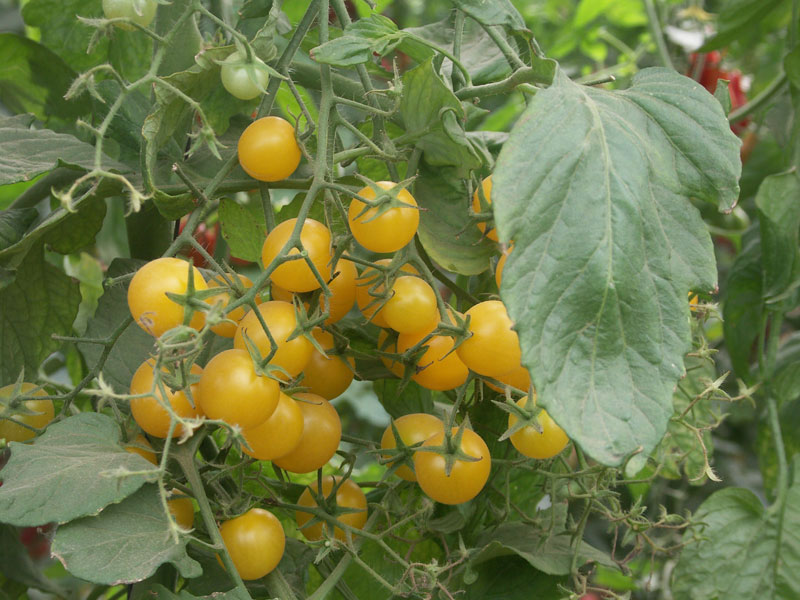
Cheri tomatoes - the Arava Valley, Israel
Of vine-ripened tomatoes, Mr Millis said they should be picked full colour off the vine, but over the past 12 months, 80% were picked red and 20% were picked semi-ripe. Today, most vine-ripened tomatoes are hydroponically grown.
To place tomato branding in an historical context, Mr Millis explained that vine-ripened tomatoes first appeared in the Sydney Basin where soil growers grew tomatoes in cool, unheated tunnel houses. Initially, they were picked well-coloured off the vine and sold loose. With a growing hydroponics industry looking for product differentation, truss tomatoes followed vine-ripened tomatoes, and were more expensive than loose or single vine-ripened tomatoes.
Mr Millis said that an ideal tomato truss or ‘hand of tomatoes’ (a term borrowed from the banana industry), should be at different stages of colour down the length of the truss, from full red at the top to gradations of red further down the truss. This is a strong benefit for consumers but one that is under-marketed.
In the seed industry, some companies define truss tomatoes as fully ripened on the vine. The green part of the truss should be as green as possible, and is used to promote freshness.
Today, Victorian hydroponic greenhouse growers dominate the truss tomato market owing to their cheaper heating costs. Mr Millis said that to grow genuine truss tomatoes, growers need cost-effective heating. “Heating is absolutely critical for growing truss tomatoes. In the Warrigal region of Victoria, it cost $9 per m2per year for natural gas heating, compared to $36 per m2per year inSydney using LPGgas.”
A mark of freshness
The calyx is left on vine-ripened and 90% of greenhouse tomatoes as a mark of freshness. In truss tomatoes, the greenness of the calyx and truss stem is also used as a mark of freshness.
The practice of leaving the calyx on was once exclusive to hydroponic growers as a group, however, many soil growers "cashed in" on this marketing strategy to get a higher price for their produce. As a general guide, Mr Millis said that greenhouse tomatoes are marketed with the calyx on, and outdoor-grown tomatoes are generally sold without the calyx. As a wholesale agent himself, he said the calyx is no longer as important. “The calyx is an easy form of reference for the uninformed consumer...and soil-grown tomatoes sold with a calyx are a poor substitute for quality,” he said.
Mr Millis predicts most greenhouse tomato growers will be out of soil within 12-18 months. “They can’t match the yields,” he said.
There are some tomatoes sold without a calyx that do represent quality. New Zealand tomatoes arrive in Australia without a calyx, which could carry pest and diseases not found here. Branded as hydroponic tomatoes, they are popular with buyers because of their quality. “ Buyers are looking for quality all the time, and they have become familiar with the quality of New Zealand tomatoes,” said Mr Millis.
The same import controls for NZtomatoes will also apply to high quality truss and single tomatoes from Holland, which are likely to reach Australian supermarkets in the near future. A draft import policy for truss tomatoes from the Netherlands was circulated by Biosecurity Australia in late May 2003. The purpose of the draft review that was sent to industry stakeholders, is to provide information on:background to the access request; pests and diseases of quarantine concern;existing import conditions for tomatoes; and proposed import conditions for tomatoes from the Netherlands.
With its review of NZtomatoes extended to include truss tomatoes, Biosecurity Australia has ruled that there is no need to proceed with Impact Risk Analyses (IRA) for Dutch tomatoes.
When Dutch tomatoes do arrive in Australia,which now seems likely,their quality may surpass anything grown in Australia. Their arrival will be good news for consumers who will pay about the same, a little more or less for quality tomatoes; but it could be bad news for Australian tomato growers unable to match Dutch production costs, yields and quality.
The fresh food industry is driven by price. New Zealand and Dutch growers adopt state-of-the-art hydroponic and greenhouse technologies, and have access to cheaper energy for greenhouse heating,and bumblebee technology to increase production yields and fruit quality. With Dutch yields in the high 60kg/m2compared to around 50kg/m2for Australian growers, they may be able to grow and land high quality tomatoes below the cost at which Australian growers can produce. Transport from Europe won't be cost prohibitive. Airlines such as KLM Cargo (www.klmcargo.com) and their partner airlines operate a fleet of cargo and combi passenger/cargo aircraft that are specially designed to deliver distinct levels of temperature and ventilation conditioning care to their customers working in the perishables industry. They currently deliver to over 185 countries worldwide.
Packaging is the most important sales tool available to food marketers.In the near future, consumers will be able to differentiate between the local product and imported tomatoes by attractive and functional, tamper-resistant packaging that conveys a message of freshness, flavour and long shelf-life, and maybe pesticide-free.
Australian consumers will also have a wider choice of tomatoes.They will experience marketing strategies that include brand building for products such as bite-sized 'Grape' tomatoes', larger-sized 'Cherry' tomatoes that come in red,yellow and orange;and egg-shaped 'Plum' or 'Paste' tomatoes that are ideal for cooking. These product segments will offer consumers more benefits and choices,and will be priced accordingly.
In a competitive market environment, it’s important for hydroponic and greenhouse growers to understand the power of brand building and relationship marketing so that they can recognise market opportunities that will allow them to grow into the future. What we know from this discussion is that fresh food wholesalers (agents) and retailers control the market environment with few opportunities for hydroponic growers to differentiate their product. We know that greenhouse and vine-ripened tomatoes may or may not be hydroponically grown, and that truss or cluster tomatoes are.We also know that the greenness of the calyx is a mark of freshness, but its importance is diminishing with the introduction of quality tomatoes from New Zealand where the calyx is removed.
With the arrival of imported tomatoes from New Zealand and, as seems likely, from the Netherlands,the industry needs to understand the different market segments and current marketing practices in order to distinguish their product from competitors including high quality overseas imports.
For the last word, Mr Millis said that there is only one way to develop the brand, but up to now growers have not been prepared to promote the product. In the absence of this promotion, supermarkets want the generic brand, which allows them to put a wide array of products under one banner.